
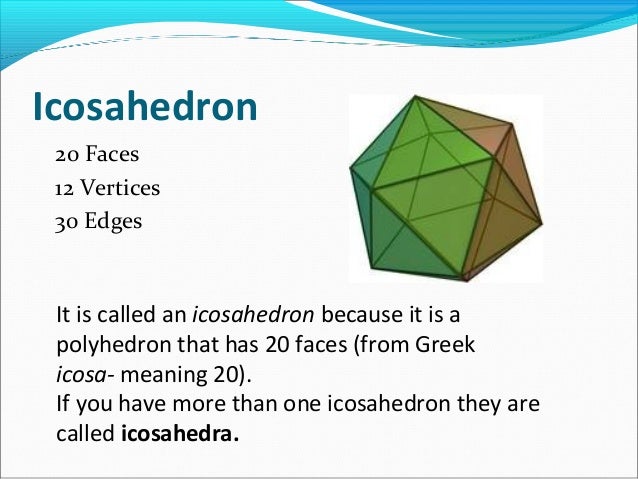
Icosahedron
It’s “a definitive study for all time, †says one researcher who’s mapping out new classes of geometric structures. Icosahedron Meaning ,†says one researcher who’s mapping out new classes of geometric structures.
The Platonic solids (or regular polyhedra) include (from left): the dodecahedron, icosahedron, cube, octahedron and tetrahedron.
It’s human nature to want to classify things, to argue that baseball is a sport, but bowling is not. Before you can sort, though, you need to clarify what your categories are. Figuring those out is often the hardest part.
Mathematicians understand this as well as anyone. It’s barely an exaggeration to say that their main enterprise is sorting. The impulse goes back to at least the ancient Greeks, who established that while there may seem to be a never-ending variety of solid objects with identical faces (so-called “regular†polyhedra), only five exist: the tetrahedron, cube, octahedron, dodecahedron and icosahedron.
,†relates to an ambitious classification project that is just getting underway. The story is, in one sense, about the search for polygons that have so-called “optimal dynamics,†meaning it’s possible to analyze every path a rebounding billiard ball could take within them. Mathematicians recently discovered two quadrilaterals with that property — dartlike shapes with angle ratios of 1:1:1:9 and 1:1:2:8. They’re the first shapes found to have optimal dynamics in a decade.
The mathematicians identified these shapes by appeal to classification. As I explain in the article, one way to study a polygon is to transform it into a point in an abstract structure called moduli space. Once in moduli space, you can study the point’s behavior — specifically, what’s called the “orbit closure†of the point. For many reasons, most of which have nothing to do with billiard balls, mathematicians would like to classify all the different varieties of these orbit closures.
Yet until recently, no one knew if this could be done. You could imagine that orbit closures might be their own special snowflakes — truly random objects that would defy efforts to say any two are alike. But in the last decade, three mathematicians —
— proved that orbit closures are always manifolds, which implies that they are neat, orderly and amenable to classification.
At the time of the manifold work, mathematicians knew of at least two types of orbit closures: dense and closed. Many mathematicians, and especially Mirzakhani, suspected there weren’t many more. In the course of trying to prove that certain other kinds of orbit closures don’t exist, the mathematician

(who was collaborating with Mirzakhani) stumbled across the first hints of the new quadrilaterals with optimal dynamics. One of those quadrilaterals Icosahedron Meaning , the 1:1:1:9 shape, ended up relating to a new kind of orbit closure, which the mathematicians describe with the term “totally geodesic.â€

Now we know that at least three kinds of orbit closures exist: closed orbits, dense orbits and totally geodesic orbits. Whether there are more (or many more) is an open question, Icosahedron Meaning , just as finding a single nugget of gold will lead people to scour an entire mountain.
“Classification is like a definitive study for all time, like writing the final book so nobody has to write another book,†Wright said.
Of course, the classification of orbit closures has only barely begun. Icosahedron Meaning , the classification of orbit closures has only barely begun.


Get highlights of the most important news delivered to your email inbox
Quanta Magazine moderates comments to facilitate an informed, substantive, civil conversation. Abusive, profane, self-promotional, misleading, incoherent or off-topic comments will be rejected. Moderators are staffed during regular business hours (New York time) and can only accept comments written in English.Â


0 Reviews:
Post Your Review