

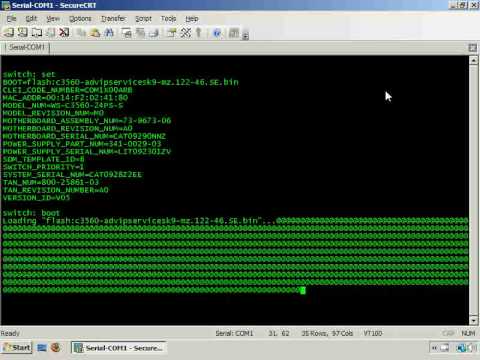
Cisco IOS Image Recovery via xMODEM
Technology that changed us: The 1970s, from Pong to Apollo
In this 50-year retrospective, we're not just looking at technology year by year, we're looking at technologies that had an impact on us, paved the way for the future, and changed us, in ways good and bad.
In many ways, 1968 was a year of transformation. From the Vietnamese Tet Offensive to North Korea capturing the surveillance ship USS Pueblo, international affairs were unsettled. We lost two greats to assassination: Martin Luther King, Jr and Robert F. Kennedy. William Shatner and Nichelle Nichols shared television's first interracial kiss. And Apollo 8 became the first manned spacecraft to orbit the moon.
Wile e2005: Creative Commons Attribution-Share Alike 3.0 Unported license.
That's where we're going to start our list. In this 50-year retrospective, we're not just looking at technology year by year, we're looking at technologies that had an impact on us, paved the way for the future, and changed us, in ways good and bad.
Looking back is an interesting exercise, because we're able to see an overall pattern of innovation, and look at technologies, products, and events that influenced who we have become, and in doing so, have changed the world.

, we all benefit from America's space program and even our military space research.
Back in 1968, Apollo 8 was originally designed to perform Lunar Module testing in low Earth orbit, but production failures were found. Instead, given that the Command/Service Module was ready for flight, engineers proposed a bold mission change: Fly a human around the moon.
History was made. Technology transfer from the space program has fueled many inventions and innovations, but it was also the excitement of this human accomplishment that drove many young minds (including that of your author) to enter STEM careers.
No doubt, many of you consider the greatest technology accomplishment of 1969 to be the lunar landing by Neil Armstrong and Buzz Aldrin. At it was. But there was another technology, one most of us take for granted, that has saved thousands upon thousands of lives.
In 1969, the Atomic Energy Commission, now the Nuclear Regulatory Commission,
to sell smoke detectors for home use. You may not realize it, but each smoke detector contains a very small amount of radioactive material, and thus it wasn't until the AEC approved home use that smoke detectors could be used to keep families safe.
, the risk of dying in a home fire is cut in half in homes with working smoke alarms.
shares billing with the Sanyo ICC-0081 and the Sharp QT-8B for bringing pocket calculators to students, engineers, and scientists the world over. The innovation then, as it is still today in our portable devices, was the ability to produce low-powered chips and reliable rechargeable batteries in a form-factor that allowed for portability.
The 4004 ran at a tenth of a megahertz, but it was huge in terms of its impact. The
, and like much of modern technology, it didn't begin that way.
Intel (who was just another company back then) was contracted by Japanese calculator maker Busicom to build a chip to reduce the costs of their calculator. Instead of merely developing a chip set specifically for use in one machine, the 4004 turned out to be a very early general purpose programmable chip, capable of much more than mere basic math. And the rest, as they say, is history.
As I'm writing this, my wife is in the other room playing
. It's a open-world game with amazing graphics and animations, presented in 4K and HDR. It brings an entire world to life with the resolution of a summer blockbuster movie.
Atari to launch cryptocurrency token for use in casinos
But in 1972, interactive games with vastly more primitive graphics only existed in laboratories, attached to giant computers. That is, until Pong.
was the first commercially successful video game, paving the way for an industry that's
Pong or Horizon Zero Dawn. It doesn't matter. My wife is a much better gamer than I'll ever be.
Martin Cooper with his 1973 handheld mobile phone prototype.
were created. Together, in combination Xmodem , in combination, informed the world we're in today. That makes 1973 a tough choice.
I'd award the year to the Alto, because it demonstrated the graphical UI we all know so well. But what about cell phones? Smartphones have beaten out the PC and Mac for digital dominance, going well beyond the Alto's UI innovations. TCP, Ethernet, and fiber optics are what make the Internet possible, and without the Internet, where would we be?
If I were writing this ten years ago, my answer would be different. But today, the mobile smartphone is the dominant technology, bar none. And

Although barcodes were patented back in 1952, the same year that
, commercial use didn't take place until 1974. That's because laser technology necessary to do the barcode scanning didn't exist until the 1970s.
The big day was June 26, 1974. It was about 8am on a
in Troy, Ohio when Marsh supermarket cashier Sharon Buchanan took a pack of Wrigley's Juicy Fruit Gum from Clyde Dawson and ran it through her newly installed barcode scanner. For
the first time anywhere, a barcode had been scanned
to determine a product price, and retailing and supply chains the world over would never be the same.
was just another kit offered to geeky hobbyists. But it changed the world. The Altair 8800 was promoted on the cover of
and became the first commercially successful microprocessor-based computer.
From paper tape to a patched-together Altair 8800, the story of my first computer
If that were all, though, we might give the award to Betamax. After all, home video is a big business today. But the Altair didn't just usher in the personal computer business, it gave birth to Microsoft. It was Bill Gates and Paul Allen who wrote the original BASIC interpreter for the 8800, and then went off to create Microsoft. You know that story. We all know that story. And the Altair 8800 was the first chapter.
For 1976, we're giving the award to a company, not a technology. It could be argued that a business is really code, its DNA driven by the personalities, values, and innovative insights of its founders.
, who sold his founder's equity stake in the world's most valuable company for $800.
, which didn't change the world nearly as much as its company and founders.
not only changed the face of personal computing...
Now, it's time for an Apple computer to make our list. The
not only changed the face of personal computing, it ushered in other key transformations, like
Xmodem

While computerized mailing lists had existed for years on the Arpanet, it wasn't until 1978 that the precursor of our modern day forums and BBSs was created. It was during the
that Ward Christensen and Randy Suess were stuck at home. Christensen had already created the canonical MODEM protocol for file transfer (you may know it today as XMODEM).
Bored, with nothing better to do, Christensen and Suess created
, a dial-in forum system that became the first BBS. There was only one phone line, so each participant had to wait until a previous user hung up to gain access.
can both be mocked and celebrated. Without BBSs, we probably wouldn't have as many trolls as we do online. But BBSs were also the first social networks, a way for consumers and interested parties to gather together, magnify their influence, and share information.
It's hard to believe now, but the idea of private, personal music didn't exist before 1979. Either you played albums on your home stereo or blared the music from cassette tapes to the entire neighborhood on your
, you could finally listen to your choice of music, in private. This reduced family bickering, made it possible for workers to listen to their own music on the job (when appropriate, of course), and gave a lift to the entire music business.
, because -- behind pizza and Chinese food -- McDonald's fuels American innovation where it counts.
Nokia handsets through the ages: Bricks, bananas, and back
From paper tape to a patched-together Altair 8800, the story of my first computers
We are obsessed with these retro computer ads from the early 1980s (TechRepublic)
SNES Classic, Nokia 3310 and other retro tech done right (CNET)
How to turn your iPhone into a business workhorse: Add these apps and accessories, and tweak these settings
How to escape from Apple's iPhone ecosystem - step by step

Lenovo introduces five new Android tablets Xmodem , starting at $70
AMD's next wave of 7nm CPUs and GPUs will be manufactured by TSMC
Please review our terms of service to complete your newsletter subscription.
By registering you become a member of the CBS Interactive family of sites and you have read and agree to the
. You agree to receive updates, alerts and promotions from CBS and that CBS may share information about you with our marketing partners so that they may contact you by email or otherwise about their products or services. You will also receive a complimentary subscription to the ZDNet's Tech Update Today and ZDNet Announcement newsletters. You may unsubscribe from these newsletters at any time.
Nokia 8110 4G, First Take: The 'banana phone' reborn
Samsung Galaxy Watch first take: Increased battery life, extensive health tracking, and enhanced ecosystem support
Apple 15-inch MacBook Pro (2018): Impressive performance at a premium price


0 Reviews:
Post Your Review