
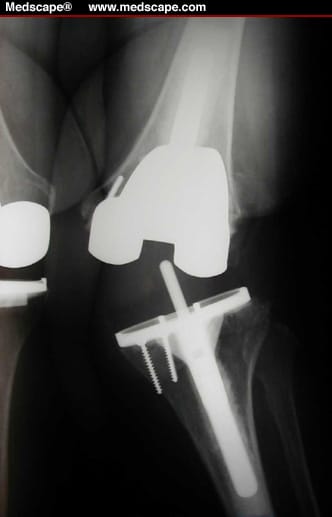
Knee Surgery: Revision of a Failed Patellofemoral Arthroplasty to a Total Knee
Winner of the MORE Award for Journalistic Excellence in Orthopedics
Courtesy of the Thayer School of Engineering Dartmouth College
Elizabeth Hofheinz, M.P.H., M.Ed. • Thu, May 3rd, 2018
Stereovision Co-Registration in Image-Guided Spinal Surgery: Accuracy Assessment Using Explanted Porcine Spines
Co-author and professor of engineering at Dartmouth College in Hanover, New Hampshire, Keith D. Paulsen, M.S., Ph.D., told
, “We had developed an intraoperative stereovision system (iSV) for brain surgery and thought it could be applied in spine surgery and eliminate some of the barriers to adoption of image-guidance for spine procedures.”
For their study, the researchers started with 10 explanted porcine spines from which they removed dorsal soft tissue to a variable degree. The team then placed bone screw fiducials in each spine and performed high-resolution computed tomography (CT) scanning.
They then obtained stereoscopic images using a tracked, calibrated stereoscopic camera system.
According to the study, “The images were processed, reconstructed, and segmented in a semi-automated manner. A multistart registration of the reconstructed spinal surface with preoperative CT was performed.”
“Target registration error (TRE) in the region of the laminae and facets was then determined, using bone screw fiducials not included in the original registration process. each spine also underwent multilevel laminectomy, and TRE was then recalculated for varying amounts of gone removal.”
, “We demonstrated the feasibility of using iSV to capture 3D surfaces of the spine intraoperatively and co-registering this information with the pre-procedure CT imaging for surgical navigations. Registration errors were small and comparable to those in standard image-guidance. The iSV approach is much faster and more convenient than image-guidance methods currently used in spine surgery, and hopefully would become more adopted as a result.”
“Image-based co-registration of spine data collected intraoperatively with iSV is not only possible but a practical option.”
The article link will be sent to the email address you provide
Augmedics Study: Positive Results for xvision Spine System
Elizabeth Hofheinz, M.P.H., M.Ed. • Wed, April 25th, 2018
Finally…surgeons can achieve x-ray vision—courtesy of an Israeli company with an augmented-reality (AR) surgical navigation system.
The company, Augmedics, is reporting on the completion of its second cadaver study using its xvision-spine system (XVS). Surgeons from Johns Hopkins Hospital, as well as two surgeons from hospitals in Israel, placed 120 pedicle screws in five separate cadavers with screw placement accuracy of 96.7% when employing the combined Heary-Gertzbein grading scheme.
“Augmedics’ xvision spine system (XVS) is an augmented-reality surgical navigation system designed to give surgeons ‘X-ray vision’ during complex procedures.” Knee Revision Poly Exchange Cpt , “Augmedics’ xvision spine system (XVS) is an augmented-reality surgical navigation system designed to give surgeons ‘X-ray vision’ during complex procedures.”
“With xvision, surgeons can see and navigate inside a patient’s body through skin and tissue, for easier, faster and safer surgeries. The system has a transparent near-eye-display headset and all the elements of traditional navigation systems.”
“It accurately determines the position of surgical tools, in real-time, and superimposes them on patient's CT data. The navigation data is then projected onto the surgeons' retina using the transparent near-eye-display headset, allowing surgeons to simultaneously look at their patient and see the navigation data without averting their eyes to a remote screen.”
Dr. Timothy Witham, professor of neurological surgery and orthopaedic surgery at the Johns Hopkins University School of Medicine, said, “Typically what we have to do during minimally-invasive spine surgery is we have to look away from where we’re working. But xvision has all the image-guided information directly in front of you in the goggles you’re wearing, while you’re placing the instrumentation.”
“We are thrilled to partner with esteemed neurosurgeons from Johns Hopkins Hospital on this second cadaver study,” said Nissan Elimelech, CEO of Augmedics. “The results of the study indicate that xvision-spine has the potential to deliver positive, precise results, and provide real-time information in a comfortable and intuitive manner. We believe that this study lends unparalleled credibility to xvision-spine and its ability to help surgeons navigate safely in surgery while always looking at their patient.”
oncology and orthopaedic surgery Knee Revision Poly Exchange Cpt ," said Dr. Daniel Sciubba, professor of neurological surgery, oncology and orthopaedic surgery, the Johns Hopkins University School of Medicine.
7D Surgical, winner of the 2015 Spine Technology Award from
, has received clearances from both the U.S. Food and Drug Administration—510(k)—and a medical device license from Health Canada that enables the commercial launch in North America of its Machine-vision Image Guided Surgery (MIGS™) system for spine surgery,
According to the manufacturer, the system employs 3D optical technologies and machine vision algorithms to eliminate any barriers to adoption of existing surgical navigational platforms. This new technology can register spinal surgery patients automatically using
Unlike time-consuming conventional image guided surgery systems that depend on intraoperative radiation, developers claim that this new platform can achieve a fast surgical workflow for spine procedures.
"When navigating the spine, surgeons traditionally have had two expensive IGS [image guided surgery] options: systems that rely on intraoperative radiation emitting devices or systems that utilize laborious manual point matching techniques," said 7D Surgical CEO Beau Standish. "We believe the inefficiencies of these systems have limited the adoption of IGS in spine procedures to less than 20%. 7D Surgical's MIGS™ system has now removed these barriers, providing surgeons and their hospitals with a superior product option."
The 7D Surgical System enables near-instantaneous Flash Registration™ of the patient's anatomy. "Guided by our product philosophy of 'surgeons designing for surgeons', we have achieved an unprecedented entire workflow time of less than 20 seconds for
spinal registration, unheard of in the spinal IGS world where such registration can interrupt surgery for up to 30 minutes," said Victor Yang, M.D., president and chief scientific officer of 7D Surgical. Yang is also Senior Scientist at Sunnybrook Research Institute, and Staff Neurosurgeon at Sunnybrook Health Sciences Centre in Toronto, where prototype MIGS™ technology has been used in more than 160 patients in clinical trials.
The MIGS™ navigation technology is embedded in an overhead surgical light, which eliminates line of sight frustrations in the operating room. The surgeon controls the software using only a foot pedal. "Our surgeons don't rely on non-sterile personnel to operate the technology," said Yang.
"Image guided surgery technology has finally caught up to the needs of a practicing spine surgeon," said Frank Cammisa, M.D., Chief Emeritus of the Spine Service at Hospital for Special Surgery in New York City.
New Study Tackles Spine Deformity Hospital Acquired Condition
Elizabeth Hofheinz, M.P.H., M.Ed. • Tue, May 9th, 2017
Spinal deformity surgery is a delicate matter…no need to make it more difficult by not doing what is possible to avoid potential pitfalls.

New research from Mount Sinai in New York City finds several key factors which can either raise or lower the risk of hospital acquired conditions in spine deformity surgery.
The study, titled “Hospital-Acquired Conditions in Adult Spinal Deformity Surgery: Predictors for Hospital-Acquired Conditions and Other 30-Day Postoperative Outcomes,” was published in the April 15, 2017 edition of
Samuel K. Cho, M.D., co-author on the study, associate professor of Adult and Pediatric Spine Surgery at Icahn School of Medicine at Mount Sinai told
, “We as spine surgeons are always interested in maximizing patient outcomes and minimizing complication rates. In particular, adult spinal deformity surgery is known to have high complication rates, some of which can be very serious.”
“We decided to utilize the nationally representative surgical data to study perioperative complications to study whether we could identify risk factors that are associated with certain complications. Further, we hoped to ascertain those risk factors that are modifiable. For example, your age is a non-modifiable risk factor. On the other hand, you can lower your complication risk by better managing diabetes.”
The authors wrote, “The 2010 to 2014 ACS-NSQIP [American College of Surgeons National Surgical Quality Improvement Program] database was queried using Current Procedural Terminology (CPT) codes for adults who had fusion for spinal deformity. Patients were divided into two cohorts on the basis of the development of an HAC [Hospital-Acquired Condition], as defined as a case of surgical site infection, urinary tract infection, or venous thromboembolism.”
“This was a retrospective analysis of a large, national database with variables that pertain to surgical patients. Because of the large numbers of patients included, we are able to perform multivariate regressions to identify independent risk factors.”
“We found that several modifiable and non-modifiable factors (age, functional status, surgical approach, utilization of osteotomies, steroid use, obesity, and operation time ≥4 hours) were associated with developing a hospital acquired condition. These hospital acquired conditions were also risk factors for other postoperative complications.
Elizabeth Hofheinz, M.P.H., M.Ed. • Wed, May 25th, 2016
MEDTECH has reached an important milestone,with the completion of 100 spinal surgeries with ROSA Spine,its robotic-assistive device for minimally invasive surgery of the spine. ROSA Spine received the CE Mark in 2014 and was granted U.S. FDA 510(k) clearance in January 2016.

Surgeries utilizing ROSA Spine have been performed by:
Michel Lefranc,a neurosurgeon at Amiens-Picardy University Hospital (France),
Michael Winking at Klinikum Osnarbrück (Germany),
Juan Torres-Reveron at Miami Valley Hospital in Dayton,Ohio (United States),
Carlos Botella at Hospital La Fe à Valencia (Spain).
The 100th case was performed by Dr. Michel Lefranc. “Having performed several procedures with ROSA Spine,I have been extremely pleased with its accuracy and versatility, ” said Dr. Lefranc in the May 11,2016 news release. “The assistance of the robot allows the surgeon to perform the surgery as it was previously planned.”
“The 100th ROSA Spine procedure is a significant milestone for our Company that only scratches the surface of the potential opportunities for our ROSA robotic surgery system, ” said Bertin Nahum,CEO and founder of Medtech. “This achievement continues to further validate our technology as an innovative approach in the spine market.”
,“The patient had a fracture of the spine (L4). The aim was to use a minimally invasive approach by placing the intra-corporeal implant associated with the implementation of acrylic cement. This is an image-guided surgery of which the most interesting part is the target of transpedicular of two intra-corporeal implants.”
“The interest and the challenge of this surgery is to place implants to optimize the spinal restoration (restoring vertebral height and a good reduction of the fracture). The other difficulty is that the target pedicle,which is the intrusion cortical pedicle,could cause a breach of lumbar nerve roots.”
“In this surgery,the robot allowed us to optimize the placement of implants through the intraoperative 3D planning,to reduce the overall procedure time. In this case,this allowed the patient to be released and back home the day after surgery.”
Study: Robotic Surgery = 5-Fold Decline in Complications
Elizabeth Hofheinz, M.P.H., M.Ed. • Wed, November 8th, 2017
A new, prospective, comparative, multi-center study sponsored by Israeli based Mazor Robotics Ltd provides quantitative evidence that robotic assist devices like the Mazor system, can reduce complications five-fold and revision surgeries seven-fold.
Mazor, which has a strategic distribution agreement with Medtronic Spine, announced the results of this significant new study on October 25.
According to Mazor, “The results demonstrate that spinal surgeries performed using Mazor Robotics’ proprietary Mazor Core technology have a five-fold reduction in surgical complications and a seven-fold reduction in revision surgeries, compared to freehand-based minimally invasive lumbar fusion surgeries.
“The study compared procedures using the Renaissance Guidance System, which is powered by Mazor Core technology, to fluoroscopic-guided, freehand procedures at one year post-surgery.”
“The study called MIS ReFRESH is a prospective, comparative, multi-center study in robotic-guided spine surgery. It is designed to assess the clinical impact of robotic-guidance, compared to fluoro-guidance on the incidence of clinical complications and revisions and use of intra-operative fluoroscopy.”
“The prospective study was initiated in 2014. There were 379 patients enrolled in the study, of which 287 were in the robotic-guided arm and 92 in the fluoro-guided control arm.”
“The results of this study completely eliminated any doubt I have had about the superiority of robotic-guided spine surgery,” commented Christopher Good, M.D. a nationally recognized orthopedic surgeon at the Virginia Spine Institute. “We see remarkable improvements in patient safety and value as well as cost savings when using Mazor Core technology-based systems.”
Ori Hadomi, chief executive officer of Mazor Robotics, told
, “This is the first time that robotic-guided spine surgery has been studied using the rigorous methodology of a prospective, controlled, multi-center study. It was designed to assess the clinical impact of robotic-guidance, compared to fluoro-guided procedures.”
“Studies of robotics often focus on accuracy, which does not always correlate to clinical outcomes. The major leap forward with MIS ReFRESH is that it goes beyond accuracy to assess the true impact of this technology on patient health and its translation to hospital economics by looking at clinical complications and revision surgeries.”
“The study revealed that spinal surgeries performed using Mazor Robotics’ proprietary Mazor Core technology have a five-fold reduction in surgical complications and a seven-fold reduction in revision surgeries, compared to freehand-based minimally invasive lumbar fusion surgeries: Relative Risk (RR) for an adverse event or complication was 5.3 times higher in the fluoro-guided control arm compared to the robotic guidance arm.
American Medical Association and OTW Mourn John McCain
Registries: They Work in Europe and Australia; Will They Here?
U.S. News Names Shirley Ryan Ability Lab: #1 in Rehab…Again!
Zimmer Biomet, Faith In Practice: Elevating Care and Spirits in Guatemala
Computerized TKR Beats Conventional TKR in New RCT Study
Haddad v Ranawat: The Medial Stabilized Knee: The “Post-Cam” Replacement
Medtronic Invests in ASC Bundled Payment Services Provider
New Emergency Pedicle Screw Removal System Launched


0 Reviews:
Post Your Review